Who Is This Programme Designed For?
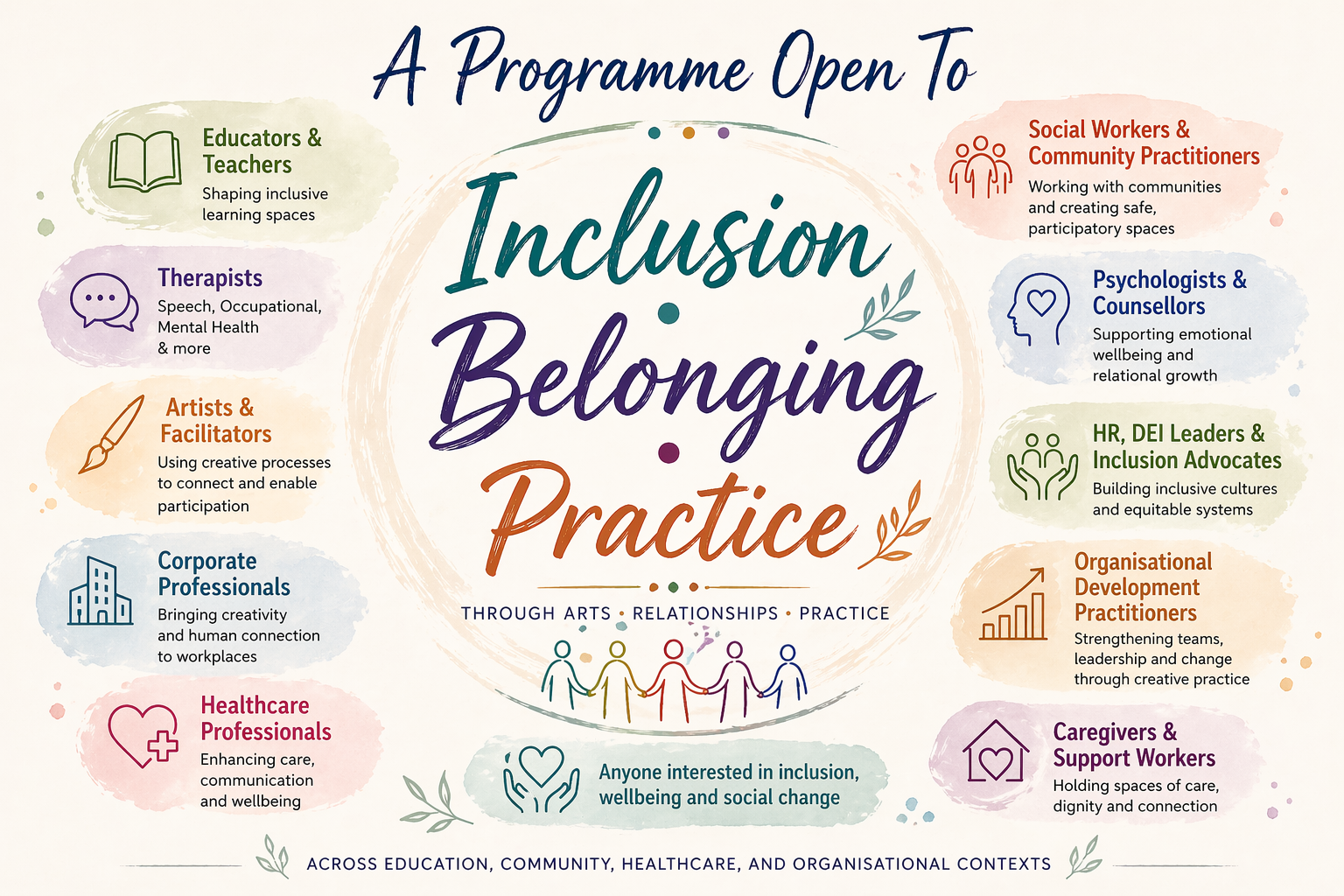
Arts Practices for InclusionTM (API) is designed for individuals who are working with or are interested in working with—diverse groups across educational, community, therapeutic, and organisational contexts.
This includes (but is not limited to) educators and special educators, psychologists, therapists (speech, occupational, mental health), social workers, community practitioners, artists, facilitators, healthcare professionals, and those engaged in inclusion, wellbeing, or social development work.

The programme is open to individuals who are able to engage with the course in English (reading, writing, and communication) or hold a graduate degree in any discipline or have a minimum of 2 years of relevant field experience or demonstrate a sustained engagement (5+ years) in the field may be considered even without formal academic qualifications.
Prior experience in the arts is not mandatory. What matters is an openness to engage with artistic processes as a medium for learning, reflection, and facilitation.
Given the practice-led nature of the programme, participants are expected to be connected to a practice context—such as a school, organisation, community setting, care environment, or group, where they can engage in ongoing field-based work as part of the course.
We also recognise that meaningful work does not always follow formal pathways. Applications from individuals who may not meet the above criteria but demonstrate strong engagement in the areas of inclusion, diversity, community work, or the arts will be considered on a case-by-case basis.
Working with Host Organisations
API is deeply rooted in real-world practice. Our engagement with host organisations is therefore not an add-on, but central to how learning and impact unfold.
We partner with organisations to support both practitioner development and organisational capacity building, drawing from over a decade of experience in arts-based inclusion practices.
Through this engagement, organisations benefit from:
Capacity Building for Teams - Exposure to arts-based methods that strengthen participation, communication, and inclusion within their existing programmes
Introductory Immersions-Short-term intensive trainings that introduce teams to API approaches and help them explore how these can be integrated into their contexts
Supervision & Ongoing Support-Regular engagement with the API faculty and supervisory team, offering feedback to practitioners, guidance on facilitation, and support in navigating group dynamics
Direct Practice Engagement-Facilitated sessions with beneficiaries that model inclusive arts-based processes, while simultaneously building the capacity of staff and caregivers
Contextualised Integration-Support in adapting API practices within the organisation’s existing systems ensuring that the work is practical, relevant, and sustainable
Documentation & Reflective Systems - Guidance in setting up observation and documentation processes that help track shifts in participation, engagement, and inclusion within groups
Access to Research Insights - Where applicable, organisations gain access to consolidated learning and research emerging from API practice, enabling them to better understand and evaluate impact
At its core, this partnership is about strengthening how spaces are held so that inclusion is not an isolated intervention, but becomes part of the everyday culture of the organisation.
Open To